1 Million Datasets and Counting: DataONE is Growing
On April 23, 2026, the DataONE network surpassed 1 million available datasets! Our data catalog spans many disciplines, from environmental science to social science, supported by over 65 member repositories. This accomplishment was possible thanks to our network members who have consistently contributed to our community.
Now, what does an accomplishment like this mean for the broader scientific community? DataONE’s growing catalog increases the visibility and citability of contributed datasets. This growth also demonstrates that our metadata standards and cross-repository interoperability are excelling. Discoverability within a catalog of one million datasets, all on a single platform, makes it easier to be found in a single search rather than hunting for datasets across several separate data repositories. This a win not just for our community, but for the broader open environmental data movement that is working towards making data more FAIR (Findable, Accessible, Interoperable, and Reusable) and open.
Search the catalog by keyword to explore what datasets are available in your research area.
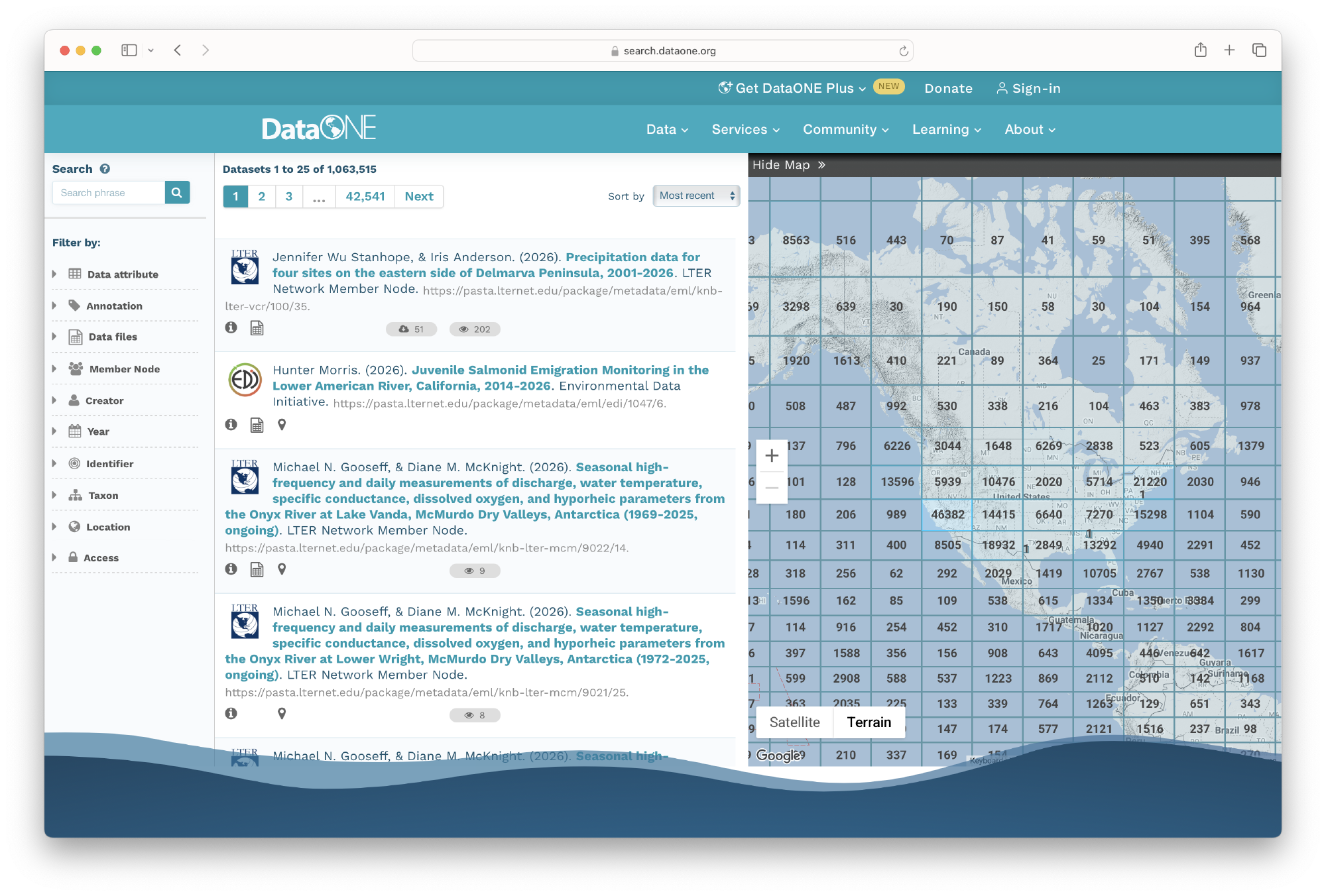
2025 marked the strongest growth period in DataONE’s 14-year history. Ten new projects and organizations joined the network, strengthening the community and expanding the range of available data. A significant share of our data catalog comes from the Pangaea data repository, which accounts for more than a half a million available datasets. This partnership has been instrumental in developing the network and enabling cross-repository discovery. While our focus remains on Earth and environmental data, a wide range of interdisciplinary data is also available for discovery.
The ten repositories added in 2025 were: Regional Seafloor Data Repository, OBIS Central, NordicanaD, OBIS-SEAMAP, Geological Survey of Denmark and Greenland (GEUS) Dataverse, International Soil Reference and Information Centre (ISRIC), Scenarios Network for Alaska + Arctic Planning (SNAP), California Institute for Biodiversity, Florida Fish and Wildlife Conservation Commission, and Global Ecosystem Research Infrastructure (GERI). These data repositories vary in focus and geography yet are complementary, collectively broadening the range of DataONE’s coverage of data across different regions and disciplines.
Alongside this milestone, our backend services have received a substantial upgrade with the release of Metacat 3.4.1. Over the past year, we enabled deployment of Metacat on Kubernetes using a Helm Chart, improving scalability for repository data managers. To learn more, visit our open-source release notes, which outline what new backend upgrades are available. We also encourage anyone interested in open source software development to check out our GitHub repositories for ways to contribute.
We are thrilled about our network’s continued growth, particularly as DataONE has transitioned to a self-sustaining model. If you are interested in adding your repository to the DataONE community to complement our catalog, let’s chat! Contact our support team via support@dataone.org to learn more.